Mina Meets: Olubusola E. Bankole, Beautifully Patterned

"People stare at you. People judge you. People whisper. People assume things." - Olubosola E. Bankole
June marks Vitiligo Awareness Month, a time to raise awareness of the autoimmune condition and amplify the voices of people living with it.
For many people, their first encounter with the word 'vitiligo' came through the late global superstar Michael Jackson, whose skin condition became the subject of intense public scrutiny. While Jackson helped bring vitiligo into public consciousness, countless people living with the condition continue to navigate misunderstanding, stigma and isolation, often without the visibility or support they deserve.
According to the Vitiligo Research Foundation, vitiligo affects approximately 1% of the global population, which is roughly 1 in every 100 people worldwide. Prevalence estimates vary across regions, with some studies suggesting even higher rates in certain populations.
While the condition is not life-threatening, its visible nature means many people living with vitiligo still face stigma, misunderstanding and social exclusion, especially in communities where awareness remains low.
Around the world, advocates are helping reshape perceptions of the condition. In Kenya, inclusion advocate and content creator Phelix Owiny shares his mental health journey through his platform, Kenyan Vitiligo Finest. Canadian supermodel Winnie Harlow has challenged beauty standards on international runways while using her platform to advocate for greater awareness.
And here in Freetown, Sierra Leone, Olubusola E. Bankole is doing the same in her own way.
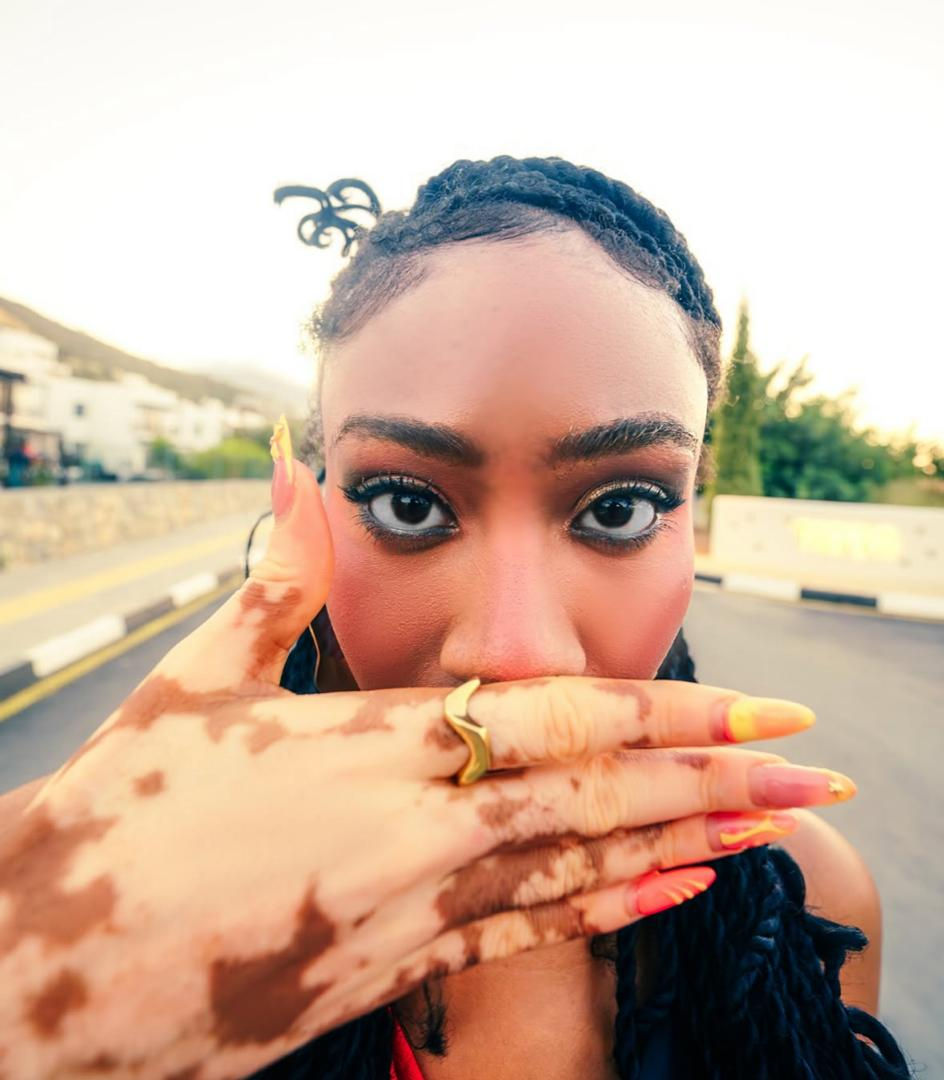
Olubusola is a Sierra Leonean-Nigerian model, activist and founder of Proudly Patterned SL, she is creating a space where people living with vitiligo can find community, confidence and visibility while educating the public about a condition that remains widely misunderstood.
To mark World Vitiligo Day (June 25) and this year’s theme, From Stigma to Strength, I virtually sat down with Olubusola to talk about her journey, the misconceptions surrounding vitiligo and why she believes everyone deserves to feel intentionally and beautifully patterned.
Me: Tell me your journey with vitiligo. When did you first notice it and what was that experience like for you?
Olubusola: I noticed vitiligo on my skin when I was in Senior Secondary School (SSS1) I was confused. I was scared. I thought it was a reaction from acrylic because I used to do my nails a lot. And during the long school holidays I would go to the salon and get my nails done. My mom was scared and really worried. We later learned that I had vitiligo and I was just confused. I was really confused. I remember asking myself 'what trajectory is my life going to take now?'. That was my raw and honest reaction and experience.
Me: How were you treated by family, friends, classmates or your wider community because of your vitiligo?
Olubusola: My family, my friends were very loving, supportive, kind and interested in my journey.
But the community, the wider community were lost and confused as I was when I first learned about vitiligo.
And I would not say I was mad. To some extent, I am human, I can feel some type of way based on how often I get these reactions from them. I try to give them grace because vitiligo is not well talked about in Sierra Leone.
And there are not people [that I know of] who are living loudly and proudly with vitiligo. So yes, there was stigma, there is still stigma, there is still misconception because every room I walk into, everyone will automatically assume that I have been through a fire accident or something fire related, or maybe hot water incident or an accident.
Me: This year’s World Vitiligo Day theme is From Stigma to Strength. What does that mean to you and how has your relationship with your skin changed?
Olubusola: This year’s theme resonates with me on a deeper level because From Stigma to Strength, it is powerful for me. And I feel like it just defines my life. Initially, when I started, I was actually scared for it to spread out on my face, because people have been telling me that I am really beautiful. So I felt like with the vitiligo patches on my face, it would take that away from me.

Over the years, I have learned to really love every patch on my skin. There is some form of attachment to every patch on my skin. Sometimes I just find myself touching my skin, rubbing my skin, staring at my skin. - Olubusola E. Bankole.
At first, I did not like to show my body. I wanted to be modest, classy because my style is elegant. But right now I like skimpy. I like to show my skin. I want people to see my patches. I take extra care of my skin, invest in skincare, try to make my skin glossy. Every time I step out, I add glitter to my skin on the vitiligo patches. So it just looks extremely different and really attractive for myself and many people around me. I really love my skin and I want to show off my skin.
Me: What inspired you to create Proudly Patterned SL?
Olubusola: To be honest, I have looked and looked and looked in the streets of Freetown and across Sierra Leone and I have not seen [visible] representation of people living with vitiligo. Proudly Patterned was designed for people to feel seen and for people living with vitiligo to know that they are enough, they are patterned, they are intentionally and beautifully patterned and loved. On TV, radio, advertisements, brand ambassadors, I didn't see or hear from people who looked like me. I created Proudly Patterned to present more opportunities for persons living with vitiligo, such as children, adults and older people so they would have a space to feel seen.

Me: Many people confuse vitiligo with albinism. What do you wish more people understood?
Olubusola: I have experiences with friends and family who have said my condition is albinism and I have had to educate them on the diffierence. With albinism, it is a genetic birth condition whereas vitiligo is an autoimmune condition that is developed with age that can be caused by stress and genetics. I also want people to know that vitiligo [currently] does not have a [known] cure. I often meet people and they tell me 'I have medicine for your condition' -- they do not. Vitiligo is an autoimmune condition where your melanocytes -- the cells responsible for producing melanin attack themselves, which results in the white patches visible on skin and hair.

Me: What would you say to someone who has recently developed vitiligo, or to parents?
Olubusola: To someone that has recently developed vitiligo, I will tell you that you are not alone.
Your skin do not define your worth. Your skin should not limit you from tapping into your higher self. Your skin should not deter you from making meaningful connections, networking, representing and speaking up. I want you to know that whenever you feel like you are alone, you can lean into the Proudly Patterned community. We will walk this path with you. We will talk to you. We will encourage you. We will boost your confidence, support your mental health.
To parents, I want you to pour more love, affirmation, confidence, support into your children. Because if they have a very good foundation, if they are loved at home, there is nothing the world can do that can put them down.
For Olubusola E. Bankole, Proudly Patterned SL is more than a platform. It is a space for visibility, understanding and community, where people living with vitiligo can feel seen, supported and beautifully patterned.
If you or someone you know is living with vitiligo in Sierra Leone and is need of resources and support, reach out to Proudly Patterned SL and visit Vitiligo Society for more information on global resources and support.


Comments